What Is Heat Sealing Cover Tape and How Does It Work?

Time:2026-10-26 Author:Sienna
0%

Heat Sealing Cover Tape is a small packaging component with a critical responsibility. It closes carrier tape pockets and protects electronic components during storage, transport, and automated assembly. Beneath its smooth surface, a layered structure usually combines a polymer film with a heat-activated sealant. The sealant bonds to the carrier tape when controlled heat, pressure, and dwell time are applied.

Walter Soroka, a respected packaging technology author, defined packaging as “the science, art, and technology of enclosing and protecting products for distribution, storage, sale, and use.” His statement explains why Heat Sealing Cover Tape requires more than simple adhesion. It must protect parts while allowing clean, consistent peeling at high speed. A reliable seal prevents dust, moisture, and component loss. A controlled peel protects delicate parts from sudden movement.

The working process sounds simple. It is not always simple. A sealing head heats the tape and carrier interface. Pressure creates contact, while dwell time allows the sealant to flow and bond. Operators then check seal strength, peel behavior, appearance, and alignment. Even a slight temperature shift can create weak seals or excessive peel force. Humidity, surface contamination, and carrier material also influence performance.

This article examines how Heat Sealing Cover Tape works, which materials support dependable sealing, and why process settings matter. Real production lines rarely behave perfectly. Small variations still deserve attention. Better results come from measured trials, documented settings, and regular inspection rather than guesswork.
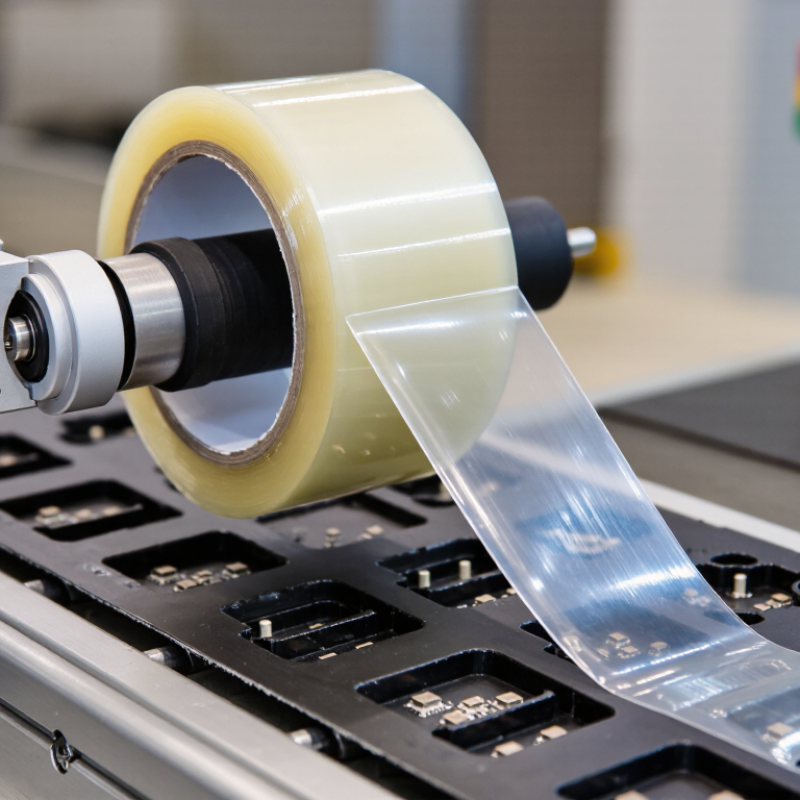
What Is Heat Sealing Cover Tape and How Does It Work?

What Is Heat Sealing Cover Tape?

Heat sealing cover tape is a transparent or translucent protective film used to close component carrier pockets. It works with a heat-activated adhesive layer. When heated, this layer softens and bonds with the carrier surface. The tape keeps small electronic parts inside their pockets during storage, transport, and automated placement.

Unlike pressure-sensitive tape, heat sealing cover tape needs controlled heat, pressure, and dwell time. A sealing head presses the tape against the carrier while applying measured temperature. Once the adhesive cools, the seal holds the tape in place. During production checks, technicians usually inspect peel strength, sealing width, and pocket alignment. A weak seal may release components. An overly strong seal can make peeling difficult or damage delicate parts.

Tips: Match the tape to the carrier material and sealing equipment. Keep the tape clean and dry. Even a small wrinkle can create an open path. Test several settings before full production. Do not rely on temperature alone; pressure and contact time matter too. In practice, the neatest setting is not always the fastest one. I have found that operators sometimes overlook surface dust, although it can change sealing results. No setup is perfect. Record each trial, including failed ones, because those details often explain later defects.

What Materials and Layers Make Up Cover Tape?

What Is Heat Sealing Cover Tape and How Does It Work?

Heat sealing cover tape is a multilayer film used to close component pockets in carrier tape. Its structure controls sealing, protection, and clean removal. The top layer is usually a strong polyester or polypropylene film. It provides stiffness, transparency, and resistance to handling damage. Some designs include an antistatic coating to reduce dust attraction and electrical risk during automated assembly.

Below the carrier film, a primer may improve bonding between layers. The most important layer is the heat-activated sealant. It softens within a controlled temperature range and bonds with the carrier tape’s sealing surface. After cooling, the seal remains secure but can peel at a measured force. This balance matters. Excessive adhesion may damage pockets or components. Weak adhesion can expose parts during transport. In practice, I have seen poor results caused by ignoring surface compatibility. The tape and carrier should be tested as one system.

Tips: Check seal strength, peel behavior, transparency, and antistatic performance under real production conditions. Confirm the sealing window instead of relying on one temperature setting. Small changes in pressure, speed, or storage humidity can affect results. There is no universal layer design. A structure that works well for small sensors may perform poorly with heavier components. Testing is still necessary, even when the film looks suitable.

What Is Heat Sealing Cover Tape?

Heat sealing cover tape is a multilayer tape used to close carrier pockets in electronic component packaging. Heat and pressure activate the sealing layer, bonding the tape to the carrier while the PET film provides mechanical support.

Carrier Film

Usually polyester (PET), providing tensile strength, dimensional stability, and transparency.

Heat-Seal Layer

A thermoplastic or heat-activated adhesive layer that softens under controlled heat and pressure.

Surface Treatment

A thin antistatic or release coating may reduce static charge and improve handling during peeling.

The chart shows representative engineering ranges in micrometres (µm). Actual layer thickness depends on sealing temperature, carrier design, peel-force requirements, and component size.

How Does the Heat-Sealing Process Work?

Heat-sealing cover tape works by bonding a heat-activated adhesive layer to a carrier film. The tape usually protects small electronic components inside a carrier pocket. During sealing, the tape is placed over the pocket and pressed by a heated sealing head. Heat softens the adhesive. Pressure spreads it across the carrier surface, while dwell time allows the bond to form.

The process needs a controlled balance of temperature, pressure, and sealing time. Too little heat may create weak edges or partial bonding. Excessive heat can distort the pocket or damage heat-sensitive components. Pressure must remain even across the tape width. A small gap can leave an unsealed channel. Not good.

In practical production checks, operators often examine peel behavior rather than relying only on machine settings. A properly sealed tape should peel smoothly, without tearing suddenly or leaving heavy adhesive residue. The peel force may change with carrier material, tape width, surface cleanliness, and storage humidity. No setting is universally correct. That assumption can fail.

A short trial run helps identify the working range. Technicians can inspect ten or more sealed pockets, record the machine conditions, and test both sealing strength and component visibility. Temperature readings should be verified near the sealing surface, because displayed machine values may not match actual contact conditions. The process seems simple, but small variations matter.

How Is Heat Sealing Cover Tape Used in Packaging?

Heat sealing cover tape is used to close pockets in carrier tape after electronic components are loaded. The tape is placed over the pocket openings, then pressed with controlled heat and pressure. This creates a continuous seal along the carrier tape’s raised edges. The sealed pockets protect components from dust, moisture, and movement during transport.

In packaging lines, the carrier tape moves through a sealing station at a steady speed. A heated sealing head bonds the cover tape to the pocket rim. Operators must match temperature, dwell time, and pressure to the tape structure. Too much heat can deform the carrier tape. Too little heat may create weak, uneven bonds. The finished tape then enters a feeder, where the cover tape is peeled away before automated placement.

Peel force matters. It should be strong enough for shipping, but controlled enough for clean removal. Quality checks often include visual inspection, peel testing, and sampling after storage. Packaging teams also monitor tape alignment and tension because small shifts can expose a pocket edge. It is not foolproof. A clean seal can still fail when components are oversized or pockets contain debris. In practice, humidity and machine wear may change results over time. Regular checks remain necessary.

What Factors Affect Its Performance and Quality?

Heat sealing cover tape closes a carrier-tape pocket around electronic components. Heat activates its adhesive layer, creating a controlled bond with the pocket rim. Performance depends on more than sealing temperature. Peel force, dwell time, pressure, tape thickness, and carrier material all interact. A practical line trial should measure peel force at the actual production speed. EIA-481-D describes controlled peel testing, including peel angle and speed. These details matter because a slow laboratory peel can hide production defects. Too little force may expose parts during transport. Too much force can lift tiny components from their pockets. Small changes matter.

Surface cleanliness is equally important. Dust, oil, moisture, and uneven pocket edges can interrupt the seal. Temperature must stay within the adhesive supplier’s validated window. Excessive heat may distort the carrier or leave adhesive residue. High humidity can also change peel behavior after storage. IPC/JEDEC J-STD-033D emphasizes moisture control for moisture-sensitive devices, which supports careful packaging conditions. WSTS forecast global semiconductor sales at 611.2 billion US dollars for 2024, showing the scale of modern component production. That report does not measure cover-tape quality, but it highlights the need for repeatable packaging processes. Operators should record peel data, seal temperature, line speed, and failure images. Perfect settings rarely remain perfect. Recheck them when materials, seasons, or equipment change.

What Is Heat Sealing Cover Tape and How Does It Work? — What Factors Affect Its Performance and Quality?

A practical data table covering construction, operating conditions, performance indicators, and quality-control factors for heat-sealing cover tape used with carrier tape packaging.

Data Dimension Typical Information or Range How It Works or Why It Matters Main Factors Affecting Performance Recommended Quality-Control Approach
Basic Function Seals the top of a component carrier tape while allowing the cover tape to be peeled away during automated assembly. The sealing layer bonds to the carrier tape flange and forms a controlled closure that protects components during handling, transport, and storage. Seal-layer chemistry, sealing temperature, pressure, dwell time, carrier-tape material, and surface cleanliness. Verify that the tape seals continuously without open channels, excessive adhesive transfer, wrinkles, or component damage.
Typical Construction Usually a multilayer film consisting of a structural backing layer, optional barrier or conductive layer, and a heat-seal layer. The backing provides tensile strength and dimensional stability, while the seal layer softens or activates under heat and pressure. Layer thickness, polymer compatibility, coating uniformity, lamination quality, and moisture or chemical contamination. Inspect cross-sections, coating uniformity, thickness consistency, adhesion between layers, and surface appearance.
Common Backing Materials Polyester and polypropylene films are widely used; other polymer structures may be selected for flexibility, strength, or antistatic requirements. The backing must resist tearing and stretching while remaining compatible with the feeder and peeling process. Film orientation, tensile strength, elongation, stiffness, puncture resistance, and temperature resistance. Measure tensile and elongation properties in both machine and transverse directions where applicable.
Typical Overall Thickness Approximately 50–100 µm Thickness influences stiffness, peel behavior, sealing response, and compatibility with the carrier-tape pocket and feeder. Backing thickness, seal-layer thickness, coating weight, thickness variation, and winding tension. Use calibrated thickness measurements at multiple points across the web and along the roll.
Heat-Sealing Temperature Often about 80–120 °C as an initial process window Heat activates or softens the seal layer so it can wet and bond to the carrier-tape flange. Seal-layer formulation, carrier-tape material, line speed, equipment calibration, and ambient temperature. Establish the lowest temperature that provides a continuous seal at the required peel force, then confirm process capability.
Dwell Time Commonly approximately 0.2–1.0 second, depending on equipment and line speed Longer contact time increases heat transfer and bonding opportunity, but excessive dwell can deform the tape or components. Heating-bar design, web speed, contact length, temperature, pressure, and thermal conductivity. Record dwell time together with temperature and pressure; do not evaluate any one setting in isolation.
Sealing Pressure Often approximately 0.1–0.4 MPa as a starting range Pressure brings the seal layer and carrier-tape flange into intimate contact and helps remove small surface gaps. Roller or bar alignment, pressure uniformity, flange width, tape flatness, and equipment wear. Check pressure distribution across the web and inspect for edge sealing, excessive squeeze-out, or pocket deformation.
Peel-Force Performance Many component-packaging applications target approximately 0.1–1.3 N, subject to the applicable specification A controlled peel force keeps the cover tape attached during shipping but allows reliable opening in the placement machine. Seal temperature, dwell time, pressure, peel angle, peel speed, material pairing, aging, and test method. Test peel force under defined angle, speed, sample width, temperature, and conditioning conditions; compare results with the packaging specification.
Seal Uniformity Continuous sealing should be present along both sealing flanges without intermittent gaps or unbonded sections. Uniform sealing prevents component loss, contamination entry, and changes in pocket atmosphere during handling. Coating streaks, dust, wrinkles, uneven pressure, poor alignment, roll telescoping, and inconsistent carrier-tape flange geometry. Use visual inspection, microscopy where needed, and periodic peel or seal-integrity sampling across the roll width and length.
Peel Mode Preferred behavior is a smooth, stable peel with limited noise, residue, tearing, or sudden force spikes. Stable peeling reduces feeder vibration and helps prevent components from shifting or ejecting from pockets. Adhesive transfer, brittle seal layers, excessive sealing energy, film stiffness, peel angle, and peel speed. Monitor peel-force curves and inspect peeled surfaces for residue, fiber tear, delamination, or seal-layer transfer.
Antistatic Performance Antistatic cover tape is commonly specified when electrostatic discharge could damage sensitive components. Conductive or dissipative layers help control charge generation and reduce electrostatic attraction during peeling and feeding. Surface resistivity, humidity, triboelectric charging, layer continuity, storage time, and contact with other materials. Measure surface or volume resistance using a defined method and condition samples at a controlled humidity and temperature.
Moisture and Storage Stability Performance can change after exposure to high humidity, elevated temperature, or prolonged storage. Moisture and heat may alter polymer stiffness, seal-layer tack, peel force, and dimensional stability. Barrier properties, packaging protection, storage temperature, relative humidity, roll age, and conditioning history. Define storage limits and use accelerated aging or environmental conditioning to verify peel and seal performance over time.
Surface Cleanliness Sealing surfaces should be free from dust, oil, release-agent residue, moisture, and loose particles. Contamination interrupts contact between the seal layer and carrier-tape flange, creating weak points or leakage paths. Handling practices, production-room cleanliness, open-roll exposure, static attraction, and inadequate packaging. Use controlled handling, protective packaging, visual inspection, and contamination checks when seal defects occur.
Dimensional Stability Low shrinkage and consistent width are important for accurate registration and stable feeding. Dimensional changes can cause tracking problems, wrinkles, edge misalignment, or inconsistent sealing across the web. Film orientation, thermal history, winding tension, storage temperature, humidity, and mechanical stress. Measure width, length change, curl, and shrinkage after defined thermal and humidity conditioning.
Compatibility with Carrier Tape The cover tape seal layer must be chemically and thermally compatible with the carrier-tape flange. Compatibility determines whether the seal is strong enough for transport but still peelable without damaging the carrier tape. Carrier-tape polymer, flange texture, recycled content, antistatic additives, surface treatment, and operating temperature. Qualify the cover tape with the actual carrier-tape construction and test both initial and aged peel performance.
Common Defects Typical defects include poor sealing, excessive peel force, adhesive transfer, wrinkles, delamination, pinholes, and uneven coating. Defects may cause component loss, feeder stoppages, contamination, unstable peeling, or reduced protection during transportation. Incorrect process settings, material variation, worn tooling, poor storage, and contamination. Use incoming inspection, in-process visual checks, peel testing, roll traceability, and root-cause analysis for nonconforming lots.
Key Acceptance Criteria Consistent thickness, width, seal integrity, peel force, antistatic behavior where required, appearance, and roll winding quality. A balanced specification ensures that the tape protects components without creating excessive opening resistance or feeding problems. Application requirements, feeder design, component sensitivity, environmental conditions, and applicable industry specifications. Approve materials using documented limits, statistical sampling, calibrated instruments, and production-line validation.

Note: The numerical ranges shown are typical starting points for process development, not universal specifications. Final settings and acceptance limits should be determined through trials using the actual cover tape, carrier tape, sealing equipment, feeder, components, and environmental conditions.

FAQS

What is heat-sealing cover tape?

It is a transparent or translucent film for closing component carrier pockets. Heat activates its adhesive layer. The tape keeps small parts inside during storage, transport, and automated placement.

How does heat-sealing cover tape work?

A heated sealing head presses the tape onto the carrier surface. Heat softens the adhesive. Pressure and dwell time help form the bond. The seal holds after cooling.

Which layers are commonly found in cover tape?

A strong polyester or polypropylene film often forms the top layer. It provides stiffness and handling protection. A primer may improve bonding between layers. The sealant layer activates under controlled heat.

What controls sealing quality?

Temperature, pressure, and contact time all affect the result. Temperature alone is not enough. Even pressure helps prevent open channels. Small gaps can expose components.

What happens when the seal is too weak?

The tape may lift during transport. Components can leave their pockets. Dust may enter through a small opening. A failed seal is easy to overlook.

What happens when the seal is too strong?

Peeling may become difficult. Excessive force can damage pockets or delicate parts. The tape might tear suddenly. That is not ideal.

How should operators check a sealed carrier?

They can inspect peel force, sealing width, and pocket alignment. The tape should peel smoothly. Heavy adhesive residue may indicate a problem. Visibility matters too.

How can production trials improve results?

Test several settings before full production. Inspect ten or more sealed pockets. Record temperature, pressure, speed, and dwell time. Keep failed trials. They may explain later defects.

What practical issues can affect sealing?

Dust, wrinkles, humidity, and surface compatibility can change results. Keep the tape clean and dry. A small wrinkle can create an open path. No setup is perfect. That deserves another check.

Conclusion

Heat Sealing Cover Tape is a protective packaging material designed to seal component carriers and keep their contents secure during storage, transport, and automated assembly. It typically combines a clear or translucent base film, a heat-activated adhesive layer, and sometimes a release or protective coating. These layers work together to provide visibility, flexibility, strong adhesion, and controlled peel performance without damaging the packaged components.

During packaging, the tape is positioned over the carrier pocket and bonded using controlled heat, pressure, and dwell time. The heat softens the adhesive, allowing it to form a reliable seal with the carrier surface. Performance depends on factors such as temperature accuracy, sealing pressure, processing speed, adhesive compatibility, film thickness, surface cleanliness, and storage conditions. Proper control helps prevent weak seals, excessive adhesion, wrinkles, contamination, or damage during peeling. Selecting the right material structure and optimizing sealing parameters are essential for consistent packaging quality and efficient handling.


Sienna

Sienna

Sienna is a skilled marketing professional with a deep expertise in our company’s core products and services. With a passion for innovation and detail, she plays a pivotal role in crafting insightful blog posts that not only highlight the unique features of our offerings but also provide valuable......